Free bill and payday timing checker
Bill Due on Payday? Check Which Paycheck Must Cover It
Compare one due date with your next two confirmed paydays. If the bill and deposit share a date, the checker flags the posting-order risk instead of assuming the new money arrives first.
One bill, one timing answer
Compare the due date with two paydays
This checks timing only. It does not move money, connect to a bank, or decide whether a payment is affordable.
Enter the bill date and two confirmed paydays.
The same date is not a posting order
A Friday payday does not prove the Friday bill drafts second
A pay stub can show Friday while the deposit becomes available later than an automatic bill draft. Until the order is confirmed, protect the bill with money that was available before Friday.
- 1Payroll: When is the deposit released?
- 2Bank: When is that deposit available to use?
- 3Biller: When is the payment actually taken?
Free rent set-aside calculator
Choose what you need to fund
Catch up before the next due date, or calculate one recurring transfer for every payday throughout the year.
Subtract what is already protected, then divide what remains.
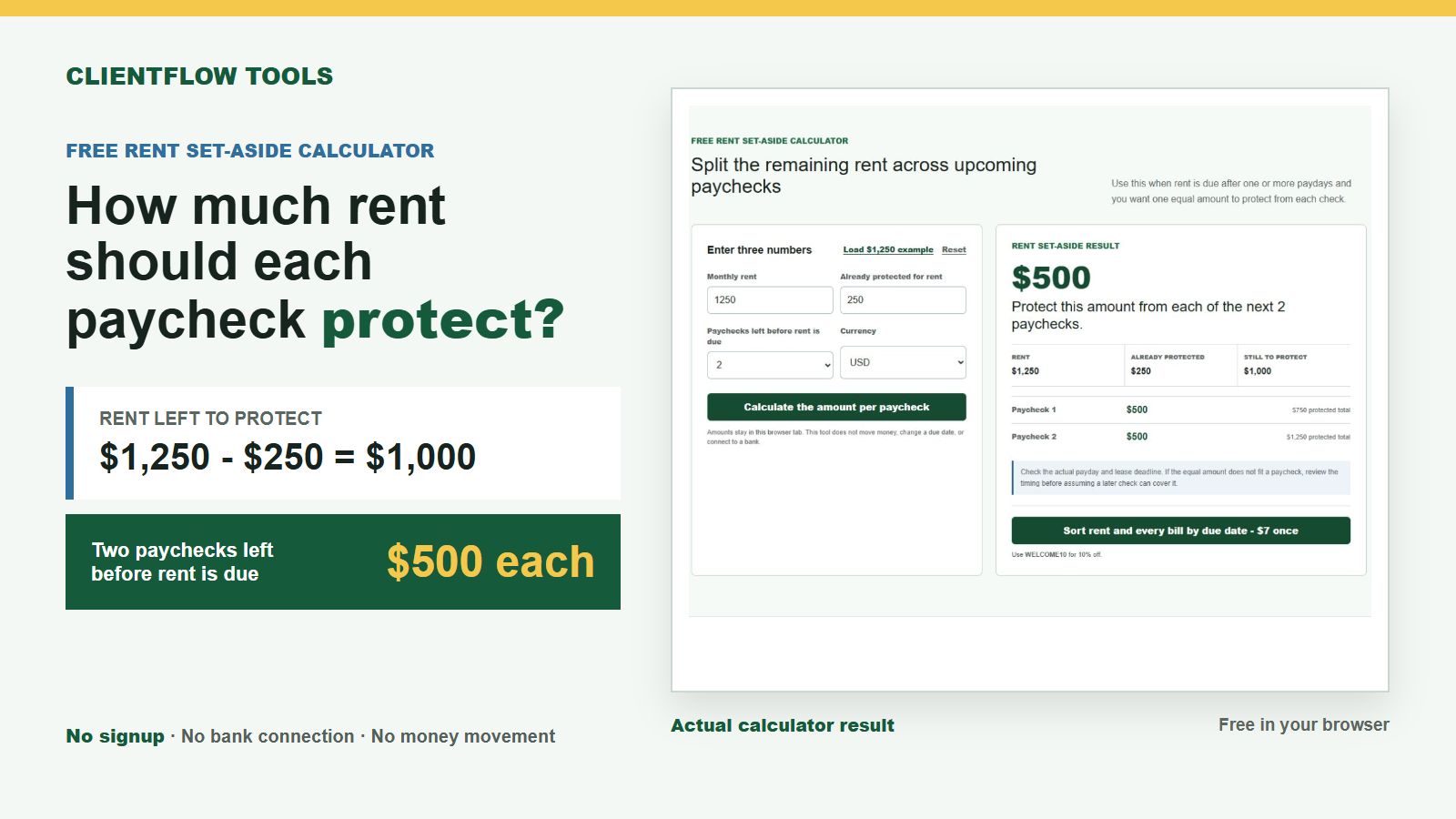
Worked rent example
$1,000 left to protect becomes $500 from each paycheck
A $1,250 rent payment minus $250 already protected leaves $1,000. With two paychecks remaining before rent is due, the equal set-aside is $500 from each check.
The calculator also shows the protected running total after every paycheck and handles cent rounding when the amount does not divide evenly.
Need the same transfer on every payday instead? Open the dedicated rent set-aside calculator and choose weekly, every two weeks, twice a month, or monthly.
The timing rule
Assign by due date, then check affordability
- 1Use confirmed payday dates, not a monthly average.
- 2Place the bill in the pay window that begins before its due date.
- 3Subtract all bills, essentials, and a reserve from that paycheck.
The Consumer Financial Protection Bureau also recommends comparing income timing with expenses in a cash-flow budget and notes that some people may ask to split a large monthly payment or align a due date with payday. See its cash-flow budget tool and bill-timing research.
More than one bill?
Sort up to six bills across two paychecks free
The free sorter adds amounts, totals, and money left for two pay windows. The $7 offline planner keeps the plan and adds rent, essentials, a reserve, backup and restore, and printable pages. Use WELCOME10 for 10% off.
Common questions
Which paycheck covers a bill due before my next payday?
A later paycheck arrives too late. Use money already available or an earlier deposit.
What if the bill and paycheck have the same date?
Confirm the posting order. If it is uncertain, use money from the earlier funding window.
Does this checker decide whether I can afford the bill?
No. It identifies timing only. Check every bill, essential cost, and reserve against the paycheck amount.
How much rent should I set aside from each paycheck?
For the next rent deadline, subtract money already protected and divide what remains by the checks arriving first. For a repeating transfer, use the dedicated rent calculator, which accounts for 52 weekly, 26 biweekly, 24 twice-monthly, or 12 monthly paychecks.