Free checking-account buffer calculator
How Much Should You Keep in Checking After Bills?
Protect the money that already has a job. Add bills, essentials, and a small buffer, then see what remains flexible before payday.
Build your checking floor
Leave this amount untouched
--Enter bills, essentials, and a buffer. Use 0 when a field does not apply.
Your amounts stay in this browser. Anonymous measurement records only that the tool was used, never the values entered.
The protected-floor method
There is no universal magic balance
The useful number depends on what must leave the account before the next paycheck. Calculate that amount first, then compare it with the balance you can actually use.
A plain-language example
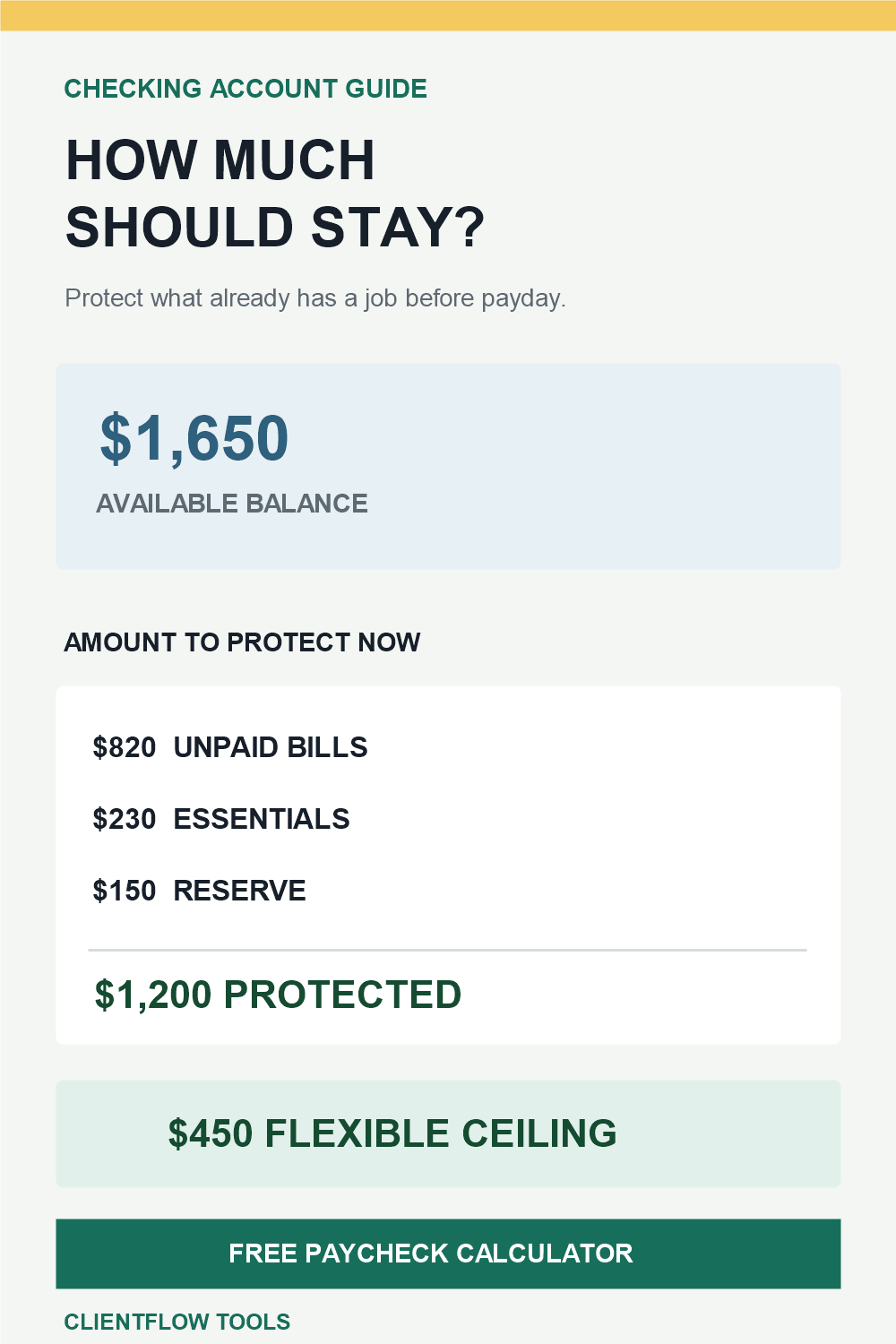
A $1,650 balance does not mean $1,650 is free to spend
If $820 is waiting for bills, $230 is needed for essentials, and $150 stays as a buffer, protect $1,200. The estimated flexible amount is $450, not the full balance.
Unsure how pending charges affect the starting balance?Why this solves a real problem
Balances and bill timing can hide what is already committed
The Consumer Financial Protection Bureau reports that payment timing, posting delays, automatic deductions, and inconsistent balance displays can make it hard to know what is actually spendable. Its overdraft guidance recommends tracking prescheduled transfers and their amounts. The Federal Reserve also reported in 2026 that 37% of adults would not cover a $400 unexpected expense entirely with cash or its equivalent, which is why the buffer is shown separately instead of being hidden in the spending result.
CFPB: payment timing and balance informationCFPB: tips for avoiding overdraftsFederal Reserve: 2025 household economic well-being report
Common questions
How much money should I keep in checking?
Add unpaid bills due before payday, essential spending still needed, and a buffer. The result is specific to this pay window, not a universal rule.
Should I use current balance or available balance?
Use money the bank currently makes available, then verify pending debits, deposits, and holds. Count each transaction once.
Is this my emergency-fund target?
No. This is a short-term checking floor for expected costs before payday. An emergency fund serves a different purpose.
What does a negative result mean?
Your protected costs exceed the available balance entered. Recheck dates and amounts, then address the gap before adding optional spending.
Need to protect individual bills?
Turn one protected total into a two-paycheck plan
The $7 planner sorts each named bill by due date into Paycheck 1 or Paycheck 2, works offline, and includes a printable six-page version.